What High-End Couples Look for When Choosing a Wedding Professional Online
Before a couple sends an enquiry, they have usually already made dozens of small decisions about you.
They may have discovered your work through Instagram, opened your website, explored several projects, read your About page, tried to understand your services and perhaps searched your name elsewhere before returning to enquire.
By the time their message reaches your inbox, the decision-making process is already well underway.
Couples are also actively comparing their options. Recent research from The Knot found that 68% of couples open multiple tabs while researching wedding professionals, while 37% describe finding vendors as challenging.
For wedding businesses operating at the higher end of the market, this matters. Beautiful work is essential, but it is rarely the only thing being evaluated. Couples are also looking for taste, relevance, confidence, professionalism and the sense that you understand the kind of celebration they are tryingto create.
01. A Point of View They Can Recognise
High-end couples are not necessarily looking for the professional who can do everything. Often, theyare looking for the person whose work immediately feels right for them.
A portfolio containing every possible style may demonstrate versatility, but it can also make it harder fora potential client to understand what you stand for. The strongest wedding brands have a recognisable point of view, whether it appears through photography, styling, colour, typography, language or the way the work itself is edited.
We see this in our own enquiries at Avelã White. Couples rarely describe their vision simply as “luxury”. Their language is much more nuanced:
modern yet timeless
classic, but with something unexpected
editorial without feeling cold
minimal, but not boring
old-world without becoming themed
bold, but still refined
Those distinctions matter because that is often where creative fit is decided.
A potential client should be able to spend a few minutes with your brand and understand not only whatyou do, but how you see things.
02. Your Best Work — Not All of Your Work
A high-end portfolio should be edited.
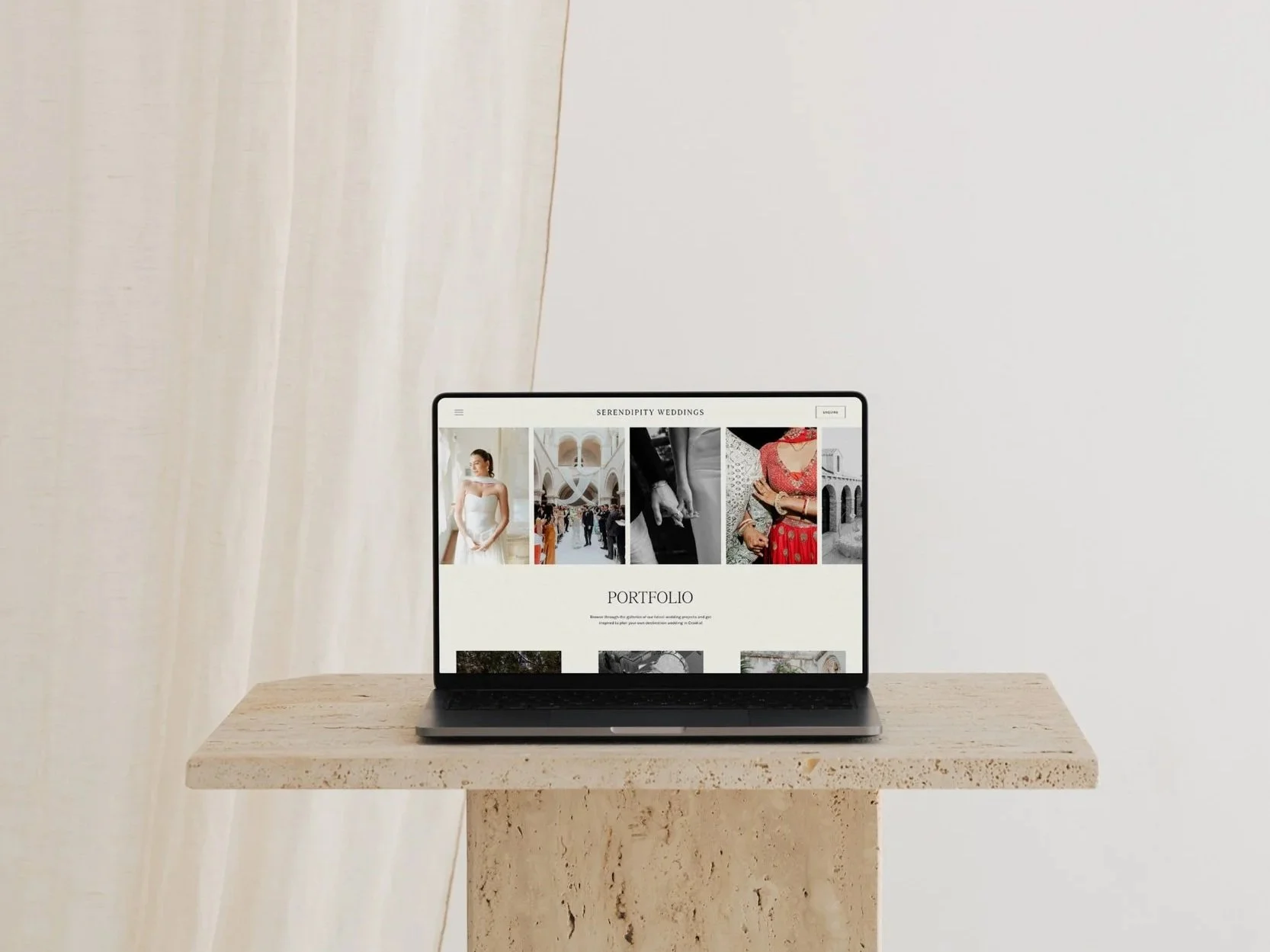
Your website is not an archive of everything you have ever created. It is a positioning tool designed to show the kind of work you want to be known for next.
When couples browse a portfolio, they are often trying to answer a very simple question: Can I imagine my wedding in this world?
The Knot’s 2026 Real Weddings Study found that photographs and examples of work were an important decision factor for 81% of couples choosing a photographer — higher than price at 73%. For visually led wedding businesses, the principle extends well beyond photography.
A planner's portfolio demonstrates taste. A florist's portfolio demonstrates composition. A stationer's portfolio shows an eye for material and detail. A venue's imagery communicates atmosphere long before somebody visits in person.
Rather than showing twenty weddings equally, consider whether eight exceptional and highly relevant projects would create a stronger impression. The sequence matters too. Your first project should not simply be the newest one; it should help define what you want to be hired for next.
03. Evidence That You Understand Their Kind of Wedding
A beautiful portfolio creates attraction. A relevant portfolio creates confidence.
A couple planning a complex destination celebration wants to know that you understand destination logistics. A multicultural couple wants to see that personal references can be handled thoughtfully rather than reduced to obvious visual clichés. Someone planning a three-day wedding weekend may need reassurance that you are comfortable with complexity, while a couple hosting 50 people may be looking for an exceptional level of intimacy and personal detail.
This does not mean every prospective client needs to see an exact replica of their wedding in your portfolio. In fact, that can work against you. They simply need enough evidence to make the imaginative leap.
Thoughtful case studies are particularly useful here because they can reveal things finished photographs cannot:
what the couple originally asked for
which constraints or challenges shaped the project
why certain creative decisions were made
how the final experience was developed
how you collaborated with the planner, venue or other creatives
This moves the portfolio from proof of aesthetics to proof of thinking.
04. A Brand That Feels as Considered as the Work
Potential clients experience your brand before they experience your service.
A beautifully produced wedding followed by an outdated website creates friction. Exceptional florals presented through inconsistent imagery create friction. A high-end planning service paired with confusing packages, broken links or a generic enquiry experience creates friction.
None of these things necessarily mean the underlying service is poor, but online, a potential client hasvery little else to judge.
Your brand becomes evidence of the standard of care you may eventually bring to their wedding.
That includes much more than the homepage. Couples notice the entire experience:
photography and art direction
typography and layout
copy and tone of voice
mobile experience
service presentation
enquiry forms
automated replies
proposals and PDFs
follow-up communication
None of these elements needs to feel elaborate. It simply needs to feel considered.
05. Clarity Around Services — Without Removing the Romance
One of the easiest ways to lose a strong enquiry is to make somebody work too hard to understand what you actually offer.
High-end does not mean vague.
Luxury brands sometimes remove so much information in pursuit of simplicity that their services become almost impossible to understand. Pricing disappears, process disappears and everything becomes an “experience”, while the potential client is left trying to work out whether you can actually help them.
Recent WeddingPro research found that 77% of couples consider pricing the most important factor when deciding which wedding professionals to contact, while 74% of professionals now share prices or ranges upfront.
That does not mean every bespoke service needs a rigid public price list. Complex projects often cannot be reduced to one number. But visitors should still be able to understand your approximate level of investment, what kind of projects you take on and what working together might involve.
There is a difference between exclusivity and ambiguity.
A strong high-end brand can preserve intrigue while still making the next step easy.
Your Work Has Evolved. Has Your Website?
At Avelã White, we create considered websites and visual identities for wedding planners and creativeprofessionals who have outgrown the brand they started with.
Strategy, art direction and digital design — built around the level of work you want to be known for.
06. A Process That Makes Them Feel Safe
At a certain level, the question is no longer only, “Can this person create something beautiful?” It becomes, “Can I trust them with this?”
Weddings involve fixed dates, significant budgets, many collaborators and unusually high emotionalstakes. Reliability therefore becomes part of luxury.
The Knot’s 2026 research found that 52% of couples considered responsiveness a top deciding factor when choosing a wedding planner. Personality was also a significant consideration, cited by half of couples.
Your website can begin building that trust before the first conversation by answering some of thequestions a serious client is already considering:
When should we enquire?
What happens after we make contact?
How involved will we be?
Do you collaborate with our planner or other creative partners?
How long does the process take?
What is included?
What information do you need from us?
You do not need to publish every internal workflow. The goal is simply to remove enough uncertainty that the client can imagine moving forward confidently.
07. Personality — Without Making the Brand Entirely About You
High-end couples still want to understand who they are hiring, particularly when the service involvesmonths of close collaboration.
But personality does not necessarily mean filling an About page with unrelated facts. A potential clientusually wants to understand something more useful: your perspective, how you work, why you make certain decisions and what kind of relationship produces your best work.
The goal is not to perform relatability. It is to make the person behind the portfolio visible enough that somebody can imagine spending time, making decisions and collaborating with them.
08. Proof Beyond the Portfolio
A photograph can show what happened. It cannot always show what it was like to work with you.
That is where testimonials, recommendations, press and professional relationships become valuable.The strongest testimonials go beyond generic praise and reveal something specific about the experience.
For example:
how calmly a planner resolved an unexpected logistical problem
how a florist interpreted an unclear creative brief
how a photographer made camera-shy clients feel comfortable
how a designer translated personal or cultural references into something contemporary
how a supplier worked alongside the wider creative team
Those details give a prospective client information that the finished photographs cannot.
The company you keep matters too. Seeing that you regularly collaborate with respected planners,photographers, venues and other creatives can create an additional layer of reassurance.
09. Consistency Across Instagram, Pinterest and Your Website
Couples rarely experience a wedding brand in one place.
They move between Instagram, Pinterest, Google, editorial features, directories and your website. Wesee this clearly in our own enquiries at Avelã White: someone might first discover a project on Instagram, later save it on Pinterest, search for the studio through Google and eventually enquire mentioning the exact typography, colour palette or collection that originally caught their attention.
The journey is not linear.
That means your brand needs to remain recognisable when it is experienced out of order. Instagram should not promise one aesthetic while your website presents another. Your portfolio should not be filled with work you would never choose to share socially. Your writing should not suddenly become cold and corporate when somebody reaches the enquiry form.
Consistency does not mean repeating the same content everywhere. It means that whichever door someone enters through, they recognise the same business.
10. Enough Information to Make a Decision
Couples are comparing options, and your website is rarely viewed in isolation. It may be open besidethree competitors.
That changes the job of the site.
You do not need more information than everybody else. You need the important information to beeasier to understand.
A serious potential client should be able to establish, without conducting an investigation:
what you do
what makes your approach distinctive
what your strongest work looks like
who you work best with
what approximate investment to expect
where you work
how the process begins
what they should do next
The easier you make it for the right person to recognise that there is a fit, the less persuasion you needonce the enquiry arrives.
11. A Sense That They Are Not Buying Something Generic
Personalisation continues to shape the way couples approach weddings. They increasingly want celebrations rooted in their own taste, relationships, places and histories rather than a collection of expected wedding details.
That affects the professionals they choose too.
Couples are not only asking whether your work is beautiful. They are asking whether you will listen, whether you will notice the details and whether the result will still feel like their wedding when yourwork is finished.
For creative professionals, there is an important balance here. Clients want to hire you because of your point of view, but they do not necessarily want your signature applied identically to every project.
The strongest positioning communicates both ideas at once:
This is how we see.
And this is how we will see you.
What High-End Couples Are Really Looking For
High-end clients are not universally looking for more. Often, they are looking for greater confidence in fewer decisions.
They want a portfolio that immediately feels relevant, a clear creative point of view and evidence that you understand the kind of celebration they are creating. They want a process that feels established, communication that builds trust and enough transparency to understand whether the investment makes sense.
Most importantly, they want the experience of your brand to reflect the standard of the work they are considering buying.
Your website does not need to convince everybody. It needs to help the right client reach oneconclusion:
They understand it.
Because by the time that person reaches your enquiry form, ideally the question is no longer whetheryour work is beautiful.
It is whether you are available.
Build a Brand That Reflects the Work You Do Now
For wedding planners and creative professionals, your website is often the first experience a potentialclient has of your taste, positioning and process.
At Avelã White, we design brands and websites that make those things clear without losing thecharacter that made your work distinctive in the first place.
read more